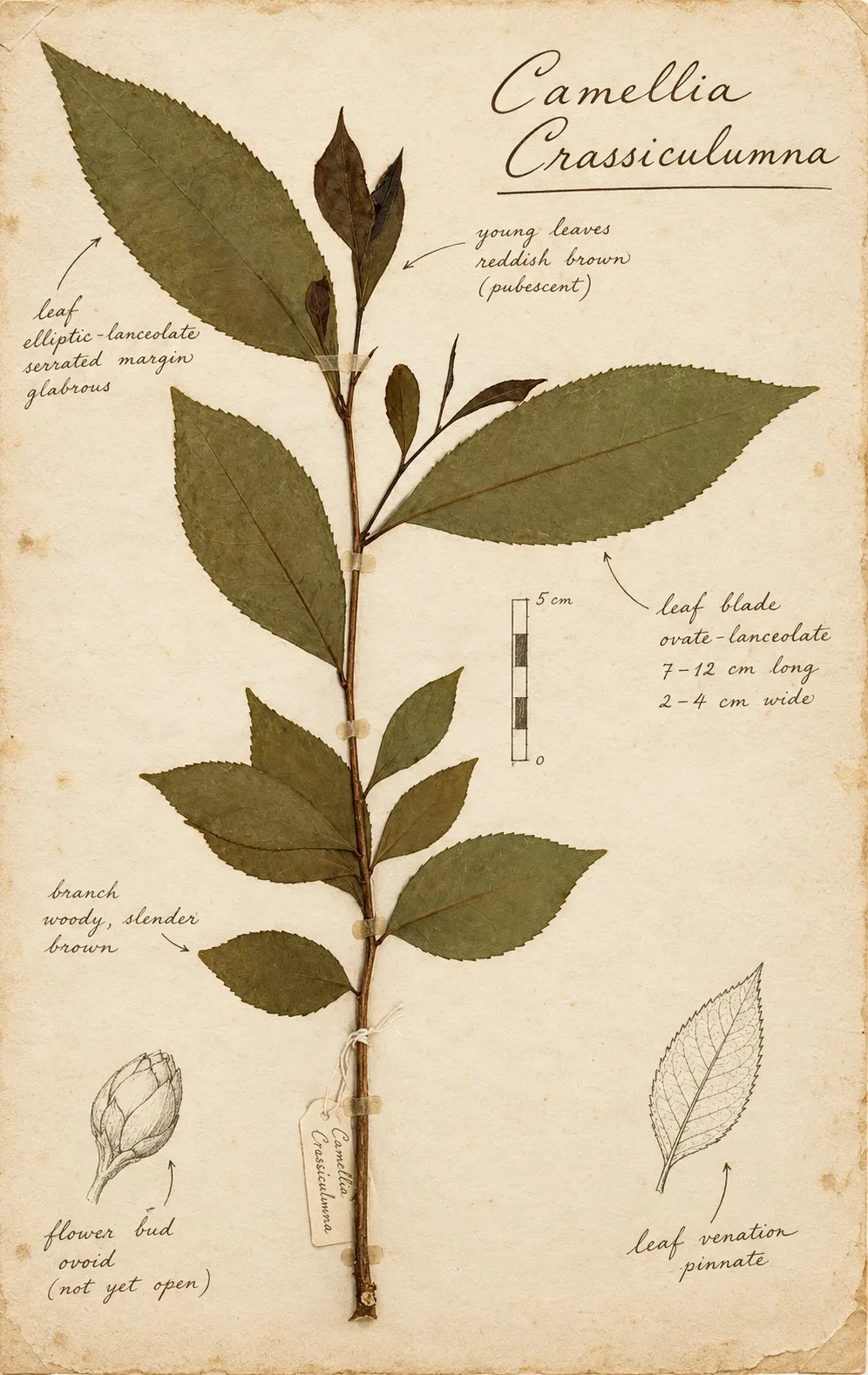
The Tea Plant You've Never Heard Of
Most people who get serious about tea eventually find themselves going down the rabbit hole of cultivars. First you learn the difference between the small-leaved Chinese variety and the big-leaved Assamica. Then you start talking about cultivars, terroir, elevation… but it’s mostly all relevant to the Camellia Sinensis plant.
I recently discovered another chapter to the story, rarely told.
I’m talking about Camellia crassicolumna — a wild, closely related species that grows in a handful of remote pockets in Yunnan and the Golden Triangle. Not a variety of sinensis. Not a cultivar. An entirely different species, like a cousin of the Sinensis and Assamica brothers. One that researchers have only seriously begun to study in recent years, and one that adds real nuance to what we think we know about tea.
First, a quick detour through the family tree
To understand where crassicolumna fits, it helps to look at the broader picture.
The tea plant behind every cup of tea in the world comes primarily in two varieties. Var. sinensis is the small-leaved Chinese type: compact bush, hardy, adapted to cooler climates, the base of most Chinese and Japanese teas. Var. assamica is the big-leaved variety, taller, more heat-loving, native to the subtropical lowlands of Assam and Yunnan, the backbone of most Pu-erh, Yunnan black teas, and many Indian teas. Often rougher than its brother Sinensis due to it’s larger leaves (more tanins, less oils) but also wilder due to less clones coming from this varietal, which is a praised caracteristic for certains types of teas – like aged teas that require a tough material to sustain years of aging.
Both share the same chromosome count. Both contain caffeine, L-theanine, and catechins. Both make tea that tastes unmistakably like tea. Despite their differences — morphological, biochemical, genetic — they belong to the same species, and they hybridise easily.
The region of Yunnan, in southwestern China, is generally considered the cradle of all this diversity. It’s where you find the oldest trees, the most varied genetic material, and the wild relatives that sit just outside the sinensis circle.
Camellia crassicolumna is one of those relatives.
What is Camellia crassicolumna, exactly?
Its Chinese name, 厚轴茶, translates roughly as “thick-shaft tea” — a reference to its notably thick floral column, one of the morphological traits that distinguish it from its cousins.
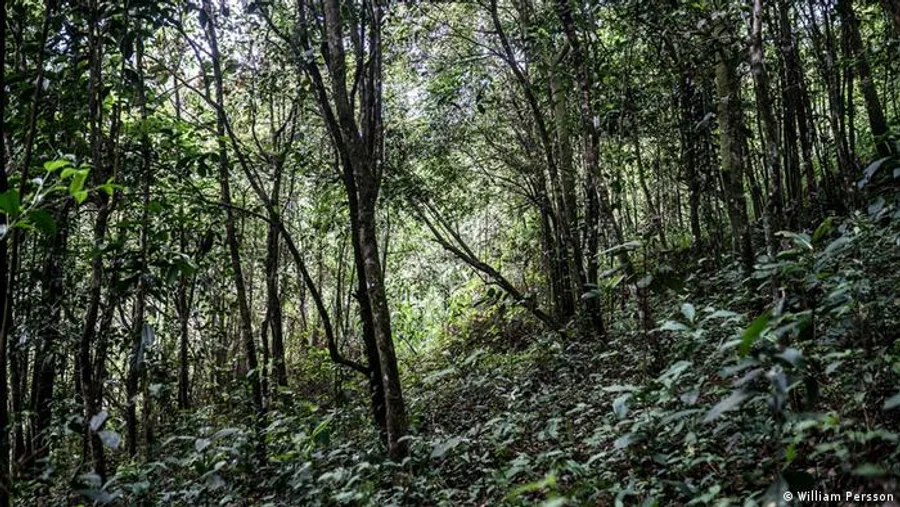
It grows wild in Yunnan, parts of Myanmar, Thailand, Laos and Vietnam. Estimates put the number of mature wild individuals at around 10,000, making it quite rare. It can grow into a substantial tree — taller and wilder-looking than the managed tea bushes we usually picture. It is not commercially cultivated at any meaningful scale. The trees grow scattered and remote, often in difficult terrain, and each tree yields very little per season. It has never become economically viable as a crop in the conventional sense.
Its leaves look, honestly, a lot like assamica. Large, deep green, relatively unremarkable to the untrained eye. If you encountered the tree without knowing what it was, you might easily mistake it for a wild tea tree of the conventional kind.
I first came across it when a local seller in Northern Thailand gave me a sample saying it was some sort of raw Puerh. I was very surpised and charmed, since I had never tasted that level of citrucy fragrance in a Sheng before. I naively thought the terroir was what was making the difference between this tea and all those I drank before.
I even sold it here, and some of you have drink it as a young Sheng Puerh, believing my labelling. For that, I apologize!
It’s maybe a year later that I was discussing with another tea seller about this particular “orange peel scent” Sheng. He brought my attention to the possibility it was a completely different tea spiece, and he was in fact right. Further inverstigations with the Thai seller revealed in was in fact, Camellia Crassicolumna.
Where it resembles Sinensis and Assamica
The family resemblance is real. Crassicolumna belongs to the same taxonomic section — Camellia sect. Thea — as the cultivated tea plant. Its flowers bear the white petals and yellow stamens of the genus. Its leaves share the characteristic serrated edges.
More meaningfully, it is rich in polyphenols — the antioxidant compounds responsible for much of what we associate with tea’s health benefits. Catechins, flavonoids, general antioxidant activity: all present, in quantities comparable to or even exceeding those found in sinensis and assamica.
Genetically, it is close enough to sinensis to potentially have contributed to the gene pool of the domesticated tea plant. Ancient hybridisation between wild relatives like crassicolumna and early assamica may have shaped what we cultivate today.
Where it diverges — and this is the interesting part
Caffeine.
Camellia sinensis, in both its main varieties, produces caffeine as its primary purine alkaloid. It’s a defining characteristic of the plant — part of what makes tea, tea.
Camellia crassicolumna is different. Its main alkaloid is not caffeine but theophylline — a related but distinct xanthine. Theophylline is the compound associated more with bronchodilation than stimulation; it’s what gives the effect of crassicolumna a different quality from conventional tea. That said, it is not completely caffeine-free. Studies show it contains caffeine in small amounts — roughly 2 to 5% of its total alkaloid content, compared to the much higher levels in sinensis and assamica. One specific sub-variety, C. crassicolumna var. multiplex, does appear to be genuinely caffeine-free in HPLC testing — but that’s the exception, not the rule for the species.
What crassicolumna offers, realistically, is a very low caffeine experience with a distinct alkaloid profile. For people who are sensitive to caffeine, it occupies an interesting middle ground: genuinely part of the tea family, but without the stimulant load.
The catechin profile also differs. Crassicolumna tends toward non-galloylated catechins, whereas galloylated versions — including EGCG, the compound most studied for health benefits and partly responsible for the astringency of green tea — dominate in Sinensis. This contributes to a taste profile that is distinctly its own. Less tannic, more sour in smell, with a rich broth like taste that lingers. I’ve heard it compared to Yabao (a tea made from tea branches buds). Personally, it’s the citrusy fragrance that really stands out for me.
In conclusion
So again, apologies to those who drank this tea from my shop thinking you were getting a caffeine high…
I’m glad I finally got to the bottom of what this mysterious tea really is. It matters for a few reasons, depending on who you are.
If you’re someone who loves tea but is sensitive to caffeine, crassicolumna is one of the most botanically interesting low-caffeine options in the family. Not a herbal substitute. Not a decaf. A wild species with a different evolutionary path, one that simply went a different biochemical direction. One that would give you maybe 10% of the caffeine amount regular tea would.
If you’re a researcher or a breeder, crassicolumna represents rare genetic material that may hold answers about the evolutionary history of the tea plant — and traits potentially worth preserving or even introducing into cultivated varieties.
And if you’re just a tea nerd — which, if you’re reading this, you probably are — Crassicolumna is a reminder that the story of tea is much bigger than the two or three varieties that dominate the market. The Golden Triangle is an extraordinarily biodiverse region, and the wild relatives of Sinensis growing in its forests are still being catalogued, studied, and understood. Some of them, like Crassicolumna, have been drunk locally for centuries without the Western world knowing much about it.
You can always be surprised in the world of tea. You think you know, and then the forest reminds you that you’re barely at the beginning.
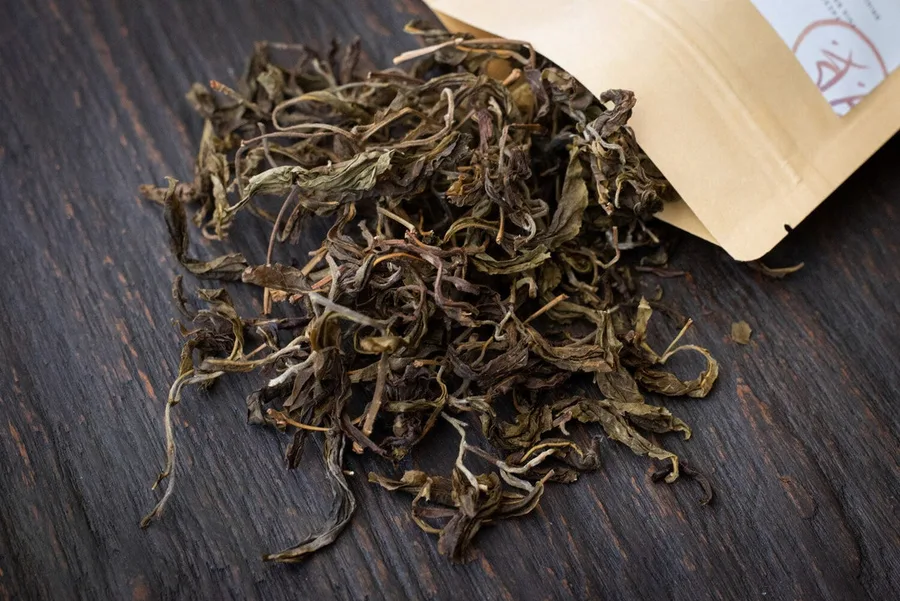
You can find this tea, the Camellia Crassicolumna Sheng Maocha, in the shop.